Special Permits to kill, take and treat whales for scientific research
The International Convention for the Regulation of Whaling (1946) is the legal agreement which establishes the International Whaling Commission. Article VIII of the Convention states that countries are permitted to kill whales for scientific research purposes. Article VIII gives responsibility for setting and regulating these catches to individual governments, not the IWC.
Although the IWC does not regulate special permit whaling, Article VIII does stipulate that any country undertaking special permit whaling should report to the IWC each time a permit is issued. It also states that the scientific information produced by the special permit whaling should be presented, at least annually, to the Commission. This information is received by the IWC Scientific Committee which reviews all special permit whaling proposals and the results of any programmes using a process known as 'Annex P,' The Scientific Committee's findings are reported to the Commission.
Historically, many countries conducted special permit whaling programmes. Below you will find a record of all the special permit catches since the 1985/86 season when the moratorium was introduced.
Click here for a table of all Special Permit Whaling Catches since 1985
Article VIII
|
Commission Review of Special Permits
The Commission often makes comments on proposals it receives from member Governments to establish or modify special permit programmes. It does this by passing Resolutions. Resolutions may be adopted by consensus or by a majority vote. These are not legally binding although incumbent on all member governments is a duty of cooperation with the IWC and its Scientific Committee, as highlighted in the ruling of the International Court of Justice (see below).
International Court of Justice
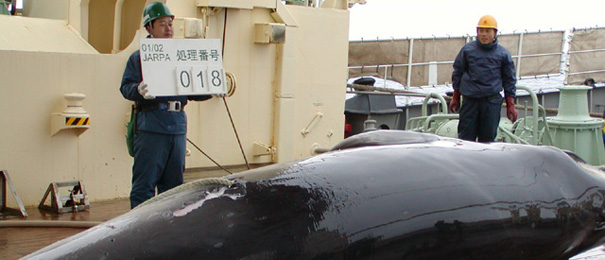
It is well documented that IWC member governments have been unable to reach agreement on special permit whaling. In 2010, the Government of Australia (with New Zealand intervening) brought a case against the Government of Japan at the International Court of Justice regarding Japan’s Special Permit programme in the Antarctic (known as JARPA II). In March 2014 the court delivered its Judgement. You can read the Judgement and related papers here.
As a result of the Judgement, the Government of Japan ended the JARPA II programme. The implications of the Judgement were discussed at the IWC Commission meeting in September 2014. Consensus could not be reached but a Resolution was adopted by vote. You can read a report of the discussion in the Chair’s Report of the meeting here. You can read the Resolution here.
NEWREP-A and NEWREP-NP special permit whaling programmes
In 2015, the Government of Japan began a new special permit whaling programme in the Antarctic, called NEWREP-A. In November 2016, the Government of Japan circulated a proposal for a new special permit programme in the North Pacific called NEWREP-NP. For both programmes, the 'Annex P' review process was followed in order to provide Scientific Committee oversight and recommendations. Both programmes continued until 2019.
It has not proved possible to reach agreement on a number of aspects of each programme. At the most recent Commission meeting in 2018, the Scientific Committee reported that the Government of Japan had provided updates on its research activities and previous Scientific Committee recommendations. On NEWREP-A, differences of view persisted between the proponents of the programme (the Government of Japan) and the Committee on priorities, whether recommendations had been met, and on the conclusions of analyses. With regard to NEWREP-NP, the Expert Panel established under the 'Annex P' process had made a series of recommendations which had been accepted by the Scientific Committee although the proponents did not agree with all of them.
In December 2018, the Government of Japan announced its withdrawal from the International Convention for the Regulation of Whaling and therefore the cessation of its special permit programme which had been conducted under Article VIII of this Convention. The Government of Japan left the IWC on 30 June 2019.